


TMT (treadmill stress test)
Treadmill stress test (TMT) in Dhantoli, Nagpur. Why it is done, how to prepare, what happens during the test and how results are used.
Medically reviewed by Dr. Ajay V. Kaduskar · Last reviewed 24 October 2026
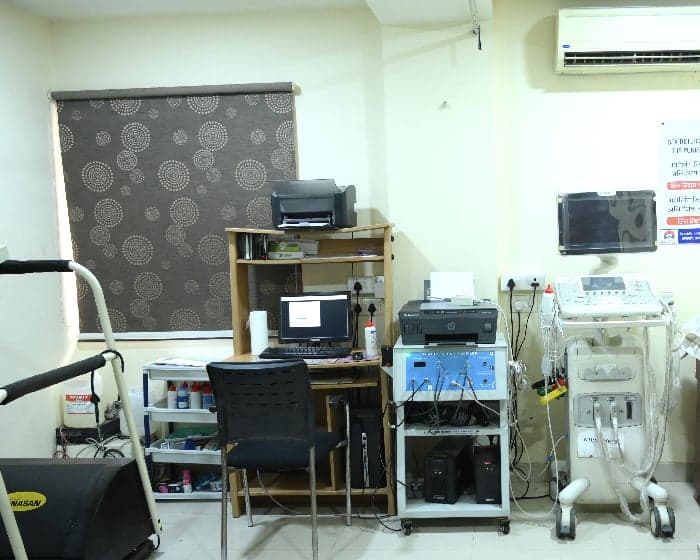
Dr. Ajay supervises every treadmill test himself, with a trained technician assisting. We follow the standard Bruce protocol, and a defibrillator, oxygen and emergency medicines are kept ready throughout.
A treadmill stress test shows how your heart responds to exercise. You walk on a treadmill while your ECG, heart rate and blood pressure are recorded. The speed and slope increase every few minutes. Some heart problems, particularly reduced blood flow from narrowed arteries, show up only when the heart is working harder.
Why it is done
- To evaluate chest discomfort or breathlessness on exertion
- To assess heart risk in people with diabetes or several risk factors
- To check exercise capacity and blood pressure response
- Before starting a vigorous exercise programme, when advised
How to prepare
- Have only a light meal 2 to 3 hours before the test; no tea or coffee for a few hours before
- Wear comfortable clothes and walking shoes
- Bring all your medicines and previous reports. Some heart and blood pressure medicines may need to be paused before a TMT, but only if your doctor tells you to. Do not stop anything on your own.
- If you have diabetes, ask how to adjust your diabetes medicines on the test day
During the test
The test usually lasts 10 to 15 minutes, including recovery. A doctor and trained staff watch your ECG and blood pressure throughout. Tell them at once if you feel chest pain, severe breathlessness, dizziness or leg pain. The test is stopped when you reach the target heart rate, feel unable to continue, or if the readings show a reason to stop.
Who should not have a TMT
A TMT is not done if you have had a recent heart attack, have unstable chest pain, certain severe valve problems, uncontrolled high blood pressure, or cannot walk on a treadmill. Your doctor will check this before the test.
Results
A "positive" TMT suggests reduced blood flow to the heart muscle during exertion and usually leads to referral to a cardiologist for further tests. A "negative" test is reassuring but does not rule out every heart problem. Your doctor will explain your result in context.
When to see a doctor
In an emergency
Chest discomfort that comes on with walking or climbing stairs and eases with rest should be assessed soon. Chest pain at rest, severe breathlessness or fainting is urgent - call 108 or 112. A treadmill test is scheduled to find out, not to be done while symptoms are unstable.
Frequently asked questions
It is done under supervision with your ECG and blood pressure watched continuously, and the test is stopped at the first sign of a problem. It is a standard, widely used test.
Wear comfortable clothes and walking shoes, avoid a heavy meal for two to three hours before, and bring your medicine list. We will tell you beforehand if any medicine needs to be paused.
Plan for 45 to 60 minutes at the clinic. The treadmill part itself is usually under 15 minutes, with time before and after for preparation, monitoring and discussion.
People with recent heart attack, unstable chest pain, severe valve disease or uncontrolled blood pressure are usually not tested this way. Dr. Ajay decides after reviewing your history, and may choose a different evaluation instead.
From our Health Library
Related services
Ready to talk to a specialist?
Call 0712 2422214 or +91 84591 41584, message us on WhatsApp, or use the appointment form. Please bring your previous reports and a list of the medicines you take.