

Continuous Glucose Monitoring
Continuous Glucose Monitoring (CGM): How It Works, Who Needs It & How to Read the Data
Written by Dr. Ajay V. Kaduskar, Diabetologist, Nagpur

MD (Medicine), PGDHSc (Diabetology), FEACD (The Netherlands)
Published · 14 minutes
Quick answer
Continuous glucose monitoring uses a wearable sensor to measure glucose in the fluid under the skin every few minutes, day and night. It shows trends, highs, lows and "time in range," the share of the day your glucose stays between 70 and 180 mg/dL. People with Type 1 diabetes, people with Type 2 diabetes on insulin or other medicines, pregnant women with diabetes, and anyone with frequent or unnoticed lows are most likely to benefit. The data should be reviewed with a doctor before any treatment changes.
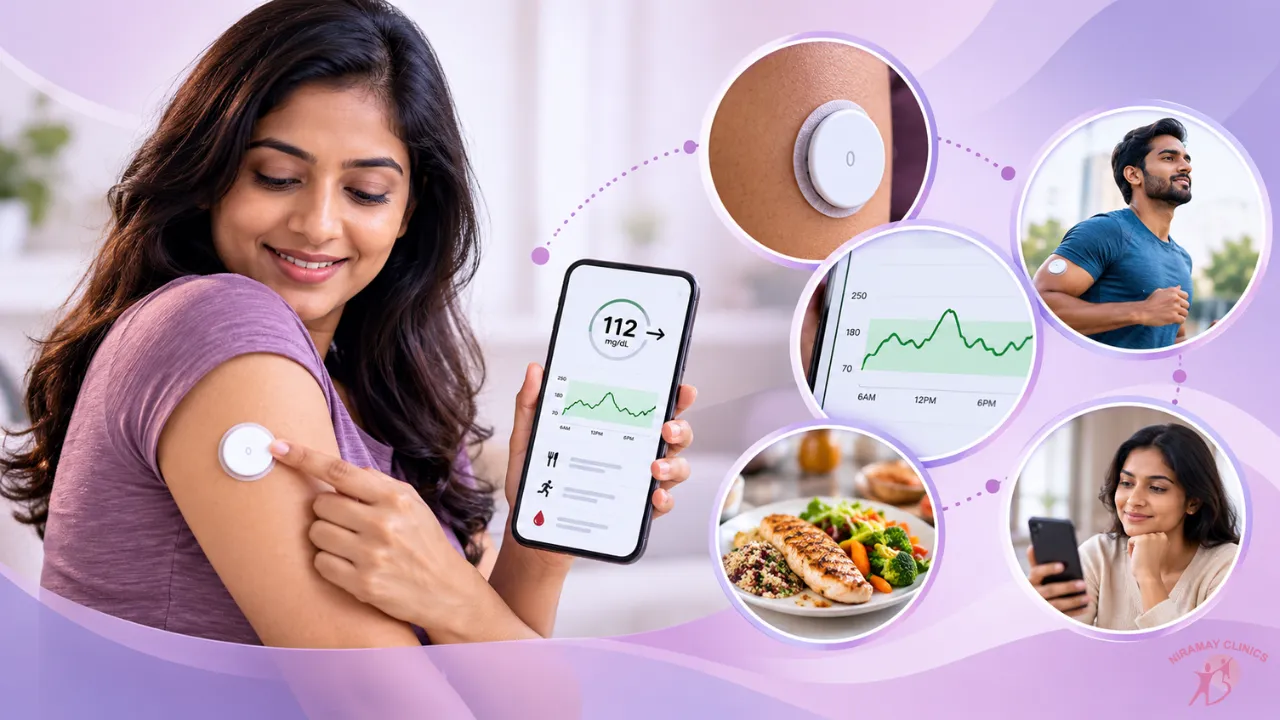
A continuous glucose monitor, or CGM, is a small sensor you wear on your arm or abdomen that checks your glucose every few minutes, around the clock, for up to two weeks. You get a moving picture of your sugar levels rather than one reading taken whenever you remember to prick your finger.
That difference matters more than it sounds. A fasting sugar of 118 mg/dL tells you about one moment on one morning. It says nothing about the 2 a.m. low you slept through or the spike that followed Sunday's lunch.
This guide covers how CGM works, who tends to get real value from it, how to read the report your doctor hands you, and where the technology falls short.
What is continuous glucose monitoring?
A CGM system has a sensor, something that sends the data, and a screen to see it on.
The sensor is a very thin, flexible filament that sits just under the skin. It is usually worn on the back of the upper arm, sometimes on the abdomen. A transmitter, either built in or clipped on, sends readings to a phone app or a small handheld reader. In some setups the readings go straight to an insulin pump.
Depending on the device, a new reading comes in every one to fifteen minutes. Across a day that adds up to hundreds of values. Most people using a glucometer manage three or four.
Sensors are generally worn for 10 to 15 days and then replaced.
How does a CGM work?
Here is the part that surprises many patients: a CGM does not measure the glucose in your blood. It measures glucose in the interstitial fluid, the thin layer of fluid that bathes the cells just beneath your skin.
The sensor filament is coated with an enzyme that reacts with glucose and produces a tiny electrical signal. The device turns that signal into a number.
Why doesn't my CGM match my finger-prick reading?
Glucose reaches the interstitial fluid a little after it appears in the blood, usually somewhere between 5 and 15 minutes later. When your sugar is steady, the two readings sit close together. When it is moving fast, after a meal, during a brisk walk, or while you are treating a low, the sensor will trail behind.
So if your glucometer says 82 and your CGM says 101 twenty minutes after you drank juice for a low, neither device is broken. They are measuring different places at slightly different times.
What do the arrows next to the number mean?
Most apps show an arrow beside the current reading. A flat arrow means glucose is holding steady. An angled one means it is drifting up or down. A straight up or straight down arrow means it is changing quickly.
In practice, the arrow can matter as much as the number. A reading of 110 heading sharply downward before bedtime calls for a different response than 110 sitting flat. If you take insulin, ask your doctor to walk you through how to respond to each arrow.
What types of CGM are there?
There are three broad kinds, and they suit different people.
| Type | How it works | Often suits |
|---|---|---|
| Real-time CGM | Sends readings to your phone or reader automatically, with alerts for highs and lows | People on insulin, pregnancy with diabetes, people who don't feel their lows |
| Intermittently scanned CGM (flash monitoring) | Records continuously; you scan the sensor with your phone to see readings. Some newer versions add alerts | Many people with Type 1 or Type 2 diabetes who want frequent data without constant alarms |
| Professional (clinic-based) CGM | Worn for a fixed period, often two weeks. You may not see readings; your doctor downloads them afterwards | A one-off pattern check before adjusting treatment |
Which devices are available, and at what price, changes fairly often in India. Your doctor can tell you what is practical right now.
CGM or glucometer: which do you need?
Think of a glucometer as a photograph and a CGM as a video.
A glucometer measures glucose in a drop of blood from your fingertip. It is accurate, cheap per test, and tells you exactly where you stand at that moment. What it can't do is show direction, fill in the hours you didn't test, or wake you when your sugar drops at 3 a.m.
A CGM fills those gaps. It records through the night, shows whether glucose is rising or falling, and in many systems raises an alarm when you cross a set limit. You'll rarely need to prick your finger, though that depends on the device.
| Glucometer | CGM | |
|---|---|---|
| Measures | Blood from a finger prick | Fluid under the skin |
| Readings | Only when you test | Every few minutes, 24 hours |
| Overnight data | Only if you wake up to test | Automatic |
| Direction of change | Not shown | Arrows and graphs |
| Alerts | No | Available on many systems |
Even with a CGM, keep your glucometer. It is your backup when the sensor fails, when a reading looks wrong, or when your symptoms don't match the screen.
What does a CGM show that HbA1c misses?
HbA1c reflects your average blood sugar over roughly the last two to three months. It's a reliable long-term marker, and it isn't going anywhere. But averages hide things.
Picture two people, both with an HbA1c of 7%. One stays fairly steady all day. The other dips below 70 overnight and climbs past 250 after most meals. Their lab reports look the same. Their risks, and what their doctors should do next, are very different.
A CGM separates these two people. It can show night lows you never felt, which foods send your sugar up and for how long, and whether your morning highs start at 4 a.m. (the dawn phenomenon, a natural hormone-driven rise before waking). It shows what a walk after dinner actually does. It also shows whether your medicine or insulin is peaking at the right time of day.
There are situations where HbA1c itself becomes less trustworthy, such as anaemia, some inherited haemoglobin variants, pregnancy, kidney disease or recent blood loss. In those cases, CGM data can help explain why the lab number and daily readings don't agree.
Who may benefit from a CGM?
The guidance here has shifted a lot. In its 2026 Standards of Care, the American Diabetes Association moved to recommending CGM from the time of diagnosis onward for anyone with diabetes who could benefit from it. It is no longer something reserved for insulin users or people with frequent lows.
That doesn't mean everyone needs to wear one permanently. It means the decision now rests on what would actually help you.
Type 1 diabetes. In many clinics, CGM has become a routine part of Type 1 care. Insulin doses shift with food, exercise and illness, and continuous data makes those adjustments safer.
Type 2 diabetes on insulin. Any insulin brings some risk of low sugar. CGM catches lows early and guides dose changes. The 2026 ADA update specifically added older adults with Type 2 diabetes on insulin to its CGM recommendations.
Type 2 diabetes on tablets or other medicines. Even without insulin, a couple of weeks on a CGM can show exactly how your meals, walks and medicines affect your sugar. Sometimes that confirms things are fine. Sometimes it shows why the HbA1c won't come down.
People who don't feel their lows. After years of diabetes, some people lose the usual warning signs: the sweating, trembling, pounding heart. Doctors call this hypoglycaemia unawareness. A CGM alert can step in where the body's signals no longer do.
Pregnancy. Targets in pregnancy are tighter and can change week to week. More on this below.
Children and teenagers. Fewer finger pricks, and parents can often follow readings on their own phones, which helps at night and during school hours.
When HbA1c and home readings don't line up. A CGM period can settle the question.
Does every person with diabetes need a CGM?
No. Someone with stable Type 2 diabetes on simple treatment may do perfectly well with regular HbA1c tests and the occasional glucometer check. A two-week CGM once or twice a year can be enough to confirm nothing is slipping.
The decision usually comes down to your type of diabetes and treatment, how likely you are to have lows, how steady your control has been, whether pregnancy is involved, cost, and your comfort with using a phone app.
There's also a simpler question. Will anyone actually look at the data? The ADA's own technology section points out that checking glucose, by itself, does nothing to lower it. The readings only help once they shape treatment and daily habits. A CGM that nobody reviews is an expensive sticker.
How to read CGM data
Most CGM reports summarise 14 days. For that summary to be trustworthy, the sensor needs to have been recording for most of the period, generally at least 70% of the time. If yours fell off on day five, the report may not tell the full story.
What is time in range?
Time in range (TIR) is the percentage of time your glucose stays between 70 and 180 mg/dL.
A TIR of 70% means you spent roughly 17 hours a day in that band. Many patients find this easier to relate to than HbA1c, because it maps onto an actual day. "You were in range from breakfast until late evening, then drifted high overnight" is a more useful conversation than "your A1c is 7.4."
Time below and time above range
Time below range is split into two levels: below 70 mg/dL, and below 54 mg/dL. The second is treated more seriously, as clinically significant hypoglycaemia.
Time above range works the same way, with one level above 180 mg/dL and a second above 250 mg/dL.
What targets should you aim for?
These international consensus targets apply to most adults with Type 1 or Type 2 diabetes:
| Measure | Range | General target |
|---|---|---|
| Time in range | 70 to 180 mg/dL | Over 70% (about 17 hours a day) |
| Time below range | Under 70 mg/dL | Under 4% (less than 1 hour a day) |
| Time well below range | Under 54 mg/dL | Under 1% (less than 15 minutes a day) |
| Time above range | Over 180 mg/dL | Under 25% (less than 6 hours a day) |
| Time well above range | Over 250 mg/dL | Under 5% |
For older adults and anyone at higher risk of lows, doctors often loosen these. A time in range above 50%, with less than 1% below 70, may be a sensible goal, because staying clear of lows matters more than squeezing sugar lower.
Treat these as starting points. Your own targets may be different, and that's a conversation for your doctor.
GMI: the cGM's estimate of HbA1c
The glucose management indicator (GMI) takes your average CGM glucose and converts it into a figure that looks like an HbA1c percentage.
GMI and your lab HbA1c are often close. Sometimes they aren't, and that doesn't automatically mean one of them is wrong. People differ in how glucose sticks to their red blood cells. Doctors look at both side by side.
Glucose variability
Coefficient of variation (CV) measures how much your glucose swings around its average. A CV of 36% or lower is generally considered stable. Higher numbers tend to go with more frequent lows, even when the average looks fine.
How to read an AGP report
The Ambulatory Glucose Profile, or AGP, is the one-page summary most CGM software produces. Its trick is to take all 14 days and lay them on top of each other, as if they all happened on a single day. Anything that repeats at the same time of day jumps out.
At the top you'll see a stacked coloured bar. Green in the middle is time in range. Yellow and orange above it are the highs. Red at the bottom is the lows. Ideally the green is large and the red is barely visible.
Below that is the main graph. The dark line through the middle is your median glucose, your typical level at each hour. Around it is a darker shaded band showing where your readings fall on most days, and a lighter, wider band showing the less common highs and lows.
When you look at your own AGP, a few things are worth noticing:
-
A narrow band close to the target zone means your days are fairly predictable.
-
A wide band at a particular hour means that part of the day varies a lot.
-
A curve sinking toward 70 overnight suggests possible night lows.
-
A hump an hour or two after breakfast or lunch points to post-meal spikes.
-
A slow climb from about 3 a.m. to 8 a.m. may be the dawn phenomenon.
Most reports also include a strip of individual daily graphs underneath. These are useful for matching a bad day to what happened: a wedding dinner, a missed dose, a long drive, a night of poor sleep.
Patterns doctors commonly look for
Some patterns come up again and again in CGM reports.
A sharp rise an hour or two after certain meals usually reflects the carbohydrate in that meal, the portion, or medicine timing. For many Indian households, breakfast is a common culprit: poha, upma, bread or tea with biscuits can push sugar up faster than people expect.
Lows between roughly 2 and 4 a.m. can mean an evening insulin dose or certain tablets are too strong for that person. High fasting readings with normal bedtime readings might be the dawn phenomenon. Occasionally they are a rebound after an unnoticed night low, which is why doctors check the overnight trace before increasing any dose.
Glucose that falls during exercise, or several hours later, reflects the body becoming more sensitive to insulin after activity. Readings that stay high through most of the day usually mean treatment needs another look. Wide swings from one day to the next often trace back to irregular meal times, sleep or medicine timing.
One odd day doesn't make a pattern. Doctors generally want to see something repeat over several days before acting on it.
And please don't adjust insulin or diabetes tablets on your own because of what you see on your CGM. Bring the report to your doctor first.
How accurate is a CGM?
Accurate enough to manage diabetes day to day. Many current systems are approved for treatment decisions without routine finger-prick confirmation. They are not flawless, though.
Readings tend to be less reliable in the first 12 to 24 hours after a new sensor goes in, and when glucose is changing quickly. Lying on the sensor during sleep can squeeze the tissue and produce a false low, sometimes called a compression low. Dehydration can throw readings off, and certain medicines or supplements affect some devices. High-dose vitamin C is a known example for some systems.
Check with a glucometer whenever you feel low but the screen says you're fine, when your symptoms and the number simply don't agree, when the device shows an error or no arrow, or whenever your CGM's instructions ask you to confirm before acting.
If in doubt, trust how you feel and check.
What's it like to wear one?
Easier than most people expect.
The sensor goes on with a spring-loaded applicator, and most people describe a quick pinch or feel almost nothing. Once it's on, you usually stop noticing it within a day. You can bathe and exercise with it, though water limits vary between devices, so check yours before swimming.
Some people get mild itching or redness from the adhesive. Rotating the site and keeping the skin clean and dry helps. Pain, swelling, spreading redness or any discharge around the sensor should be shown to a doctor.
Sensors generally need to come off before an MRI, CT scan or certain X-rays, so tell the radiology staff you're wearing one. If you're travelling, pack a spare sensor and your glucometer.
Is CGM useful during pregnancy?
Pregnancy with diabetes needs tighter glucose control, because higher sugar levels can affect both mother and baby. Levels can also shift quickly as the weeks go on.
For women with Type 1 diabetes, CGM is widely used in pregnancy, and the consensus target is stricter: more than 70% of the time between 63 and 140 mg/dL, with very little time below that. For Type 2 diabetes in pregnancy and for gestational diabetes, the evidence on CGM-specific targets is still being built, and finger-prick testing remains a central part of care.
Targets in pregnancy should always come from your treating team, and CGM data should be reviewed regularly by both your diabetologist and your obstetrician.
Should people without diabetes use a CGM?
CGMs are now sold as wellness gadgets, and plenty of people without diabetes are curious. For someone with prediabetes or obesity, a short trial can be eye-opening about how food, sleep and activity move their numbers.
A few words of caution, though. Glucose naturally rises after eating in everyone, and watching that happen on your phone can cause needless worry or push people toward overly strict diets. Normal CGM ranges for people without diabetes are also less clearly defined. And a CGM cannot diagnose diabetes or prediabetes. That still takes a fasting glucose, an HbA1c or an oral glucose tolerance test.
If you're worried about prediabetes or insulin resistance, start with a proper medical assessment rather than a sensor.
What does a CGM cost in India?
Cost depends on the system, how long each sensor lasts, and whether you wear one continuously or just now and then. The sensors are the main ongoing expense, since each is replaced every 10 to 15 days.
Brands and prices in India change often enough that it's best to ask your doctor or a verified supplier what's currently available. It's also worth talking through whether you need continuous use or periodic two-week checks, whether alerts matter for your safety, whether a phone-based system or separate reader suits you, and whether your insurance or employer covers any of it.
For many people with Type 2 diabetes, a two-week CGM every few months, reviewed properly with the doctor, gives much of the benefit at a far lower cost than wearing one all year.
How Niramay Clinics uses CGM data
The report itself is only half the value. The other half is the conversation you have about it.
At Niramay Clinics in Dhantoli, Nagpur, diabetes care looks beyond blood sugar to the heart, kidneys, eyes and nerves, with the aim of preventing long-term complications. CGM data fits into that picture by answering practical questions. Are there hidden lows making treatment unsafe? Which meals or times of day need work? Is a new medicine or insulin dose doing what it should? Is sugar steady enough during pregnancy?
Dr. Ajay V. Kaduskar has more than 20 years of experience treating Type 1 and Type 2 diabetes, diabetes in pregnancy, obesity and related metabolic conditions. At the clinic, CGM is used alongside HbA1c, clinical examination, complication screening and a lifestyle plan that fits how the patient actually lives.
When to get urgent medical help
A CGM alert is useful, but some situations need medical attention whatever the screen says.
Get urgent help for signs of a severe low: confusion, strange behaviour, being unable to eat or drink, a seizure, or passing out. If someone can't swallow safely, don't put food or drink in their mouth; call for emergency help. Seek care too for lows that keep coming back after treatment with fast-acting sugar.
Very high glucose together with vomiting, stomach pain, fast or deep breathing, drowsiness or a fruity smell on the breath can signal diabetic ketoacidosis, especially in Type 1 diabetes. This needs emergency treatment. So do signs of severe dehydration with persistently high sugar, and any chest pain, breathlessness, sudden weakness, slurred speech or drooping of the face.
If your CGM and your body disagree, go with your body and check with a glucometer.
Common misconceptions about CGM
Some people assume a CGM means fewer doctor visits. It gives you more information, but deciding what to do with it still needs a clinician.
Others think CGM is only for people on insulin. Current guidance covers a much wider group, including people with Type 2 diabetes on other medicines.
Seeing your sugar rise after a meal can feel alarming at first. Some rise is normal. What matters is how high it goes, how long it stays there, and whether it happens every day.
Many people expect the CGM and glucometer to match exactly. Small differences are normal, because they measure different fluids with a short time gap.
A good HbA1c doesn't make CGM pointless either. It can still hide frequent lows or big swings.
And the insertion is not the ordeal people imagine. Most feel a brief pinch, if anything.
A quick recap
-
A CGM measures glucose every few minutes through a small sensor usually worn for 10 to 15 days.
-
It picks up patterns that HbA1c and occasional finger pricks miss, particularly night lows and post-meal spikes.
-
Time in range (70 to 180 mg/dL) is the headline number, with a general target of over 70% for most adults with diabetes.
-
The AGP report stacks two weeks onto one page so repeating patterns are easy to spot.
-
Current international guidance supports CGM for a much wider group of people with diabetes, based on individual need.
-
Sensor readings trail blood glucose slightly, so keep a glucometer as backup.
-
Any change to medicine or insulin should be made with your doctor.
For years, diabetes care relied on a handful of readings and a lab test every few months, with a lot of guesswork in between. CGM fills in those gaps. Patients and doctors can finally see what glucose does through ordinary days of work, meals, sleep and exercise.
It isn't a treatment, and not everyone needs one all the time. But for many people, even a couple of weeks with a sensor makes their diabetes easier to understand and their treatment safer to adjust. The sensible first step is to talk with your doctor about whether it fits your situation, and how the data will actually be used.
Sources and further reading
Frequently asked questions
Most sensors are worn for about 10 to 15 days, depending on the system, and then replaced with a new one, ideally on a different spot to give the skin a rest. Clinic-based professional CGMs are usually worn for a fixed two-week period. Afterwards, the doctor downloads the recorded data and goes through the patterns with you.
For most adults with Type 1 or Type 2 diabetes, the usual goal is more than 70% of the day between 70 and 180 mg/dL, roughly 17 hours. Time below 70 mg/dL should ideally stay under 4%. Older adults and people prone to lows often have gentler targets, because avoiding hypoglycaemia comes first. Your doctor will set goals that suit you.
Not quite. A glucometer tests blood directly and is very accurate for a single moment. A CGM reads the fluid under the skin, so it can lag several minutes behind, especially when sugar is changing fast. What a CGM offers is continuous data and direction of change. Most people who use a CGM keep a glucometer for backup checks.
Yes, and this is one of its most useful features. Because the sensor records continuously, it catches overnight lows that people often sleep through without noticing. Real-time systems can sound an alarm when glucose falls below a set level. Doctors reviewing CGM reports frequently find night-time lows that lead to safer changes in medicine or insulin timing.
Not necessarily, though it can help. Current international guidance supports CGM for people with Type 2 diabetes on non-insulin medicines when it improves management. Even two weeks of data can show how your meals, activity and tablets affect your sugar. Whether ongoing use makes sense depends on how stable your control is, your treatment plan and cost.
Most sensors are water-resistant, so bathing, showering and exercise are usually fine. Water depth and time limits differ between devices, so check your instructions before swimming. Heavy sweating can loosen the adhesive, and some people add an overpatch to keep it secure. In contact sports, a sensor can occasionally get knocked off, so a little extra care helps.
The Ambulatory Glucose Profile is a standard one-page CGM summary, usually covering 14 days. It shows your time in range, average glucose and glucose management indicator, along with a graph that overlays all the days as though they were one. That makes repeating patterns, like post-breakfast spikes or overnight lows, much easier for your doctor to spot.
Most people feel a quick pinch, and some feel nothing at all, when the sensor is applied. After that, the thin filament under the skin is rarely noticed during normal activity. A few people get mild itching or irritation from the adhesive. If you notice pain, swelling, spreading redness or discharge around the site, have a doctor take a look.
Related reading
- CGM vs Glucometer: Which Is Better for Type 2 Diabetes?
- What Is Time in Range (TIR) in Diabetes?
- How to Read a CGM Report: AGP and Glucose Patterns
- Does Everyone With Type 2 Diabetes Need a CGM?
- CGM in Pregnancy: When It Helps and What to Know
Related guides: Gestational Diabetes (GDM)
If you would like advice suited to your own reports and medicines, you can book an appointment or visit Niramay Clinics in Dhantoli, Nagpur.
Related services


More from the Health Library
Ready to talk to a specialist?
Call 0712 2422214 or +91 84591 41584, message us on WhatsApp, or use the appointment form. Please bring your previous reports and a list of the medicines you take.