

Continuous Glucose Monitoring
What Is Time in Range (TIR) in Diabetes?
Written by Dr. Ajay V. Kaduskar, Diabetologist, Nagpur

MD (Medicine), PGDHSc (Diabetology), FEACD (The Netherlands)
Published · 4 min read
Quick answer
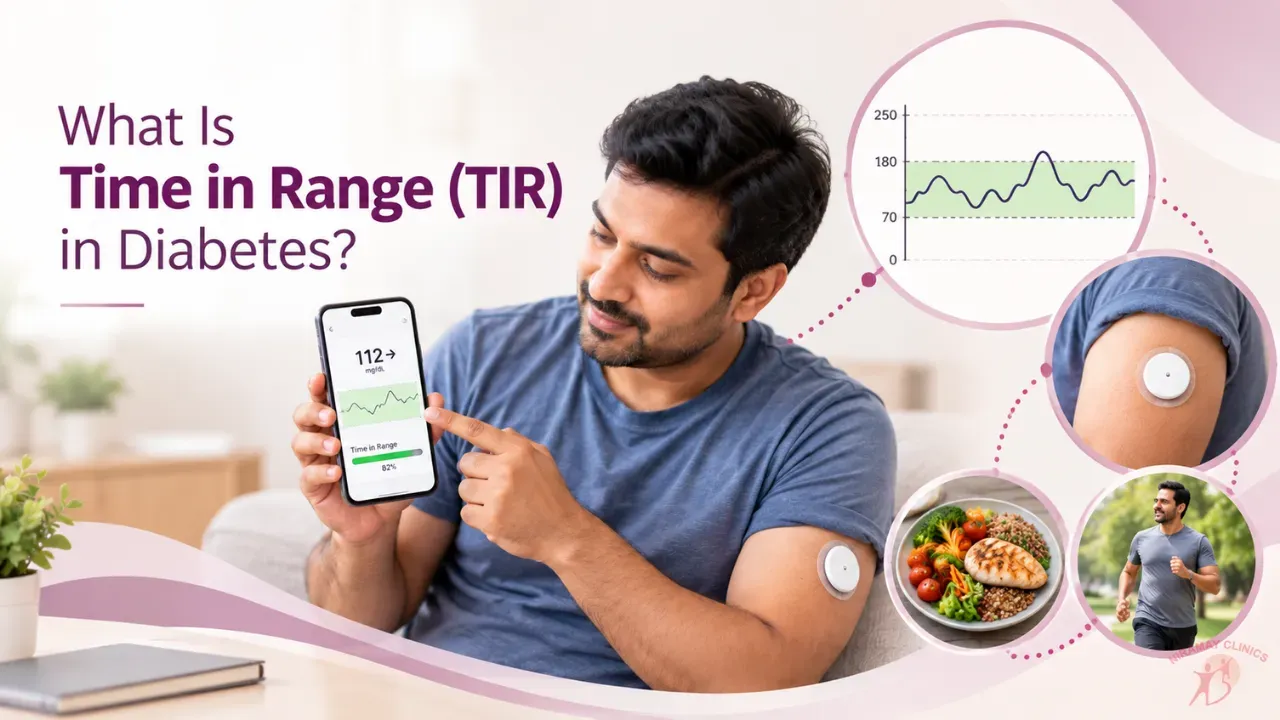
Time in range (TIR) is the percentage of time during a day that your glucose stays within a target range, usually 70 to 180 mg/dL, as measured by a continuous glucose monitor (CGM). For most adults with diabetes, the goal is more than 70 percent of the time in range (about 17 hours a day), less than 4 percent below 70 mg/dL and less than 25 percent above 180 mg/dL.
HbA1c tells you your average blood sugar over three months. But two people with the same HbA1c can have very different days, one steady and the other swinging up and down. Time in range shows this difference.
Why was TIR introduced?
HbA1c is an average. It does not show how high or low your sugar goes, or how often. A person with frequent highs and lows can have a "normal" average. TIR captures this variation and is closely linked to complications, along with HbA1c.
What are the standard ranges?
International consensus targets for most adults with type 1 or type 2 diabetes:
| Range | Glucose level | Target time |
|---|---|---|
| Time in range | 70 to 180 mg/dL | More than 70 percent |
| Time above range (high) | Above 180 mg/dL | Less than 25 percent |
| Time above range (very high) | Above 250 mg/dL | Less than 5 percent |
| Time below range (low) | Below 70 mg/dL | Less than 4 percent |
| Time below range (very low) | Below 54 mg/dL | Less than 1 percent |
Targets differ for older adults, people at high risk of low sugar and pregnancy. In pregnancy, the usual range is tighter, about 63 to 140 mg/dL.
How does TIR relate to HbA1c?
A TIR of about 70 percent roughly matches an HbA1c of around 7 percent. Each 10 percent change in TIR corresponds to about 0.5 percent change in HbA1c. But HbA1c and TIR are not interchangeable. TIR adds detail about daily swings and low sugar.
How is TIR measured?
You need a CGM. The device records glucose every few minutes. The software calculates TIR for the last 14 days, as long as the sensor was worn at least 70 percent of the time. Your report will show the percentage in each range.
How can you improve your TIR?
Food
-
Choose balanced meals with fibre, protein and fewer refined carbohydrates.
-
Watch portion sizes of rice, roti and sweets.
-
Eat meals at regular times.
Activity
A 10 to 15 minute walk after meals can reduce post-meal peaks. Regular exercise improves insulin sensitivity.
Medicines
Take medicines as prescribed. Your doctor may adjust doses or change medicines based on your CGM patterns.
Sleep and stress
Poor sleep and stress raise sugar. Aim for regular sleep and relaxation.
Learn your patterns
Look for repeated highs after a particular meal, early morning rises or night-time lows. Small adjustments to those moments can add up.
Is TIR useful without a CGM?
TIR needs continuous data. But the idea of aiming for steady sugar, rather than only a good average, is valuable for everyone.
When should you see a doctor?
See your doctor if your time in range is less than your target, if your time below 70 mg/dL is more than 4 percent, or if you have night-time lows or symptoms of hypoglycaemia.
A quick recap
-
TIR is the percentage of time your sugar is within 70 to 180 mg/dL.
-
The common goal is more than 70 percent TIR with minimal low sugar.
-
TIR complements HbA1c by showing daily variation.
-
It requires a CGM.
-
Food, activity, sleep and medicine adjustments improve it.
Time in range turns your glucose graph into a simple, useful goal. Even small improvements in TIR are linked to better outcomes. To use CGM data effectively, consult Dr. Ajay V. Kaduskar, a diabetologist at Niramay Clinics in Nagpur.
Sources and further reading
Frequently asked questions
For most adults, more than 70 percent of the time between 70 and 180 mg/dL, less than 4 percent below 70 mg/dL and less than 25 percent above 180 mg/dL. Targets differ for older adults and in pregnancy.
They are complementary. HbA1c shows average glucose over three months, while TIR shows daily swings and lows. Doctors use both together.
The target range is tighter, about 63 to 140 mg/dL, with a goal of more than 70 percent of the time within it. Your pregnancy team will set your specific goals.
About 14 days, with the sensor worn for at least 70 percent of that time, gives a reliable estimate.
Yes, with a CGM. It helps those on insulin and also those trying to understand the effect of food and activity on their sugar.
Balanced meals, post-meal walks, regular medicines, good sleep and review of your patterns with your doctor can all raise TIR.
Related reading
- Full guide: continuous glucose monitoring
- CGM vs Glucometer: Which Is Better for Type 2 Diabetes?
- How to Read a CGM Report: AGP and Glucose Patterns
- CGM in Pregnancy: When It Helps and What to Know
- Does Everyone With Type 2 Diabetes Need a CGM?
If you would like advice suited to your own reports and medicines, you can book an appointment or visit Niramay Clinics in Dhantoli, Nagpur.
Related services


More from the Health Library
Ready to talk to a specialist?
Call 0712 2422214 or +91 84591 41584, message us on WhatsApp, or use the appointment form. Please bring your previous reports and a list of the medicines you take.